Our Purpose-Driven
& Life-Giving

Academic Philosophy and Curriculum

PFGA-MMondays

Motivational Mondays

Starting the Week Off Right

Each week at Pope Francis Global Academy begins with intention. Motivational Mondays set the tone for learning, leadership, and personal growth by helping students reflect on who they are becoming — not just what they are learning.

Through school-wide messages, classroom conversations, and moments of encouragement, students are reminded of their potential, their responsibility to others, and the values that guide our community. These weekly touchpoints help build confidence, resilience, and a growth mindset.

It’s a simple practice with powerful impact: students begin each week feeling supported, inspired, and ready to grow.

Math & Science Lab

High School-Level Exploration Begins Early

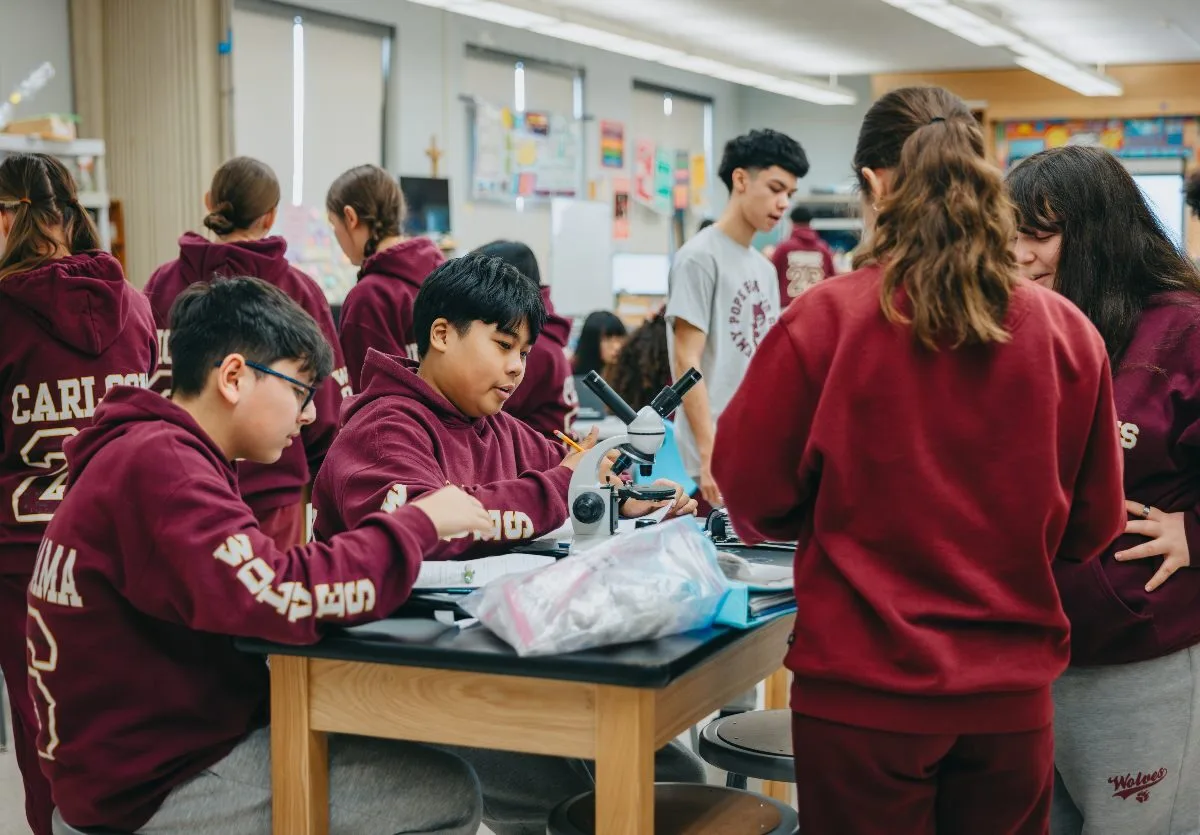
Not every Catholic school offers a dedicated, high-functioning Math and Science Lab — and ours is comparable to a high school lab environment.

Beginning in 3rd grade and continuing through junior high, students engage in hands-on, inquiry-based learning in a fully equipped lab space designed for real experimentation and discovery. This isn’t textbook-only science. Students apply concepts, test hypotheses, and work collaboratively in a structured lab setting that prepares them for advanced coursework in high school and beyond.

By introducing lab-based learning earlier, we give students the confidence and foundational skills they need to think critically, solve problems, and explore STEM pathways with curiosity and independence.

PFGA-Lab

STEM Integration

Building Thinkers and Problem-Solvers

Pope Francis Global Academy is not a STEM-only school — and that’s intentional. We believe in educating the whole child. At the same time, we thoughtfully integrate STEM principles throughout our curriculum to help students develop critical thinking, problem-solving, and analytical skills.

Beginning in elementary grades, students engage in hands-on math and science learning in our dedicated lab spaces. Lessons are inquiry-based, encouraging students to ask questions, test ideas, and explore real-world applications. As students progress into junior high, they deepen their understanding through structured lab experiences that mirror high school-level expectations.

STEM at PFGA is not about gadgets or trends. It’s about cultivating curiosity, resilience, collaboration, and logical reasoning — skills that prepare students for high school success and an increasingly complex world.

Music Residency

A Performance Experience Like No Other

At Pope Francis Global Academy, we don’t offer a traditional weekly music class. Instead, students participate in a structured Music Residency — 10 weeks in the fall and 10 weeks in the spring — designed to prepare them for a full-scale concert experience.

During each residency, students work intensively with a music director who prepares every class to perform two songs, including one bilingual (Spanish) selection. This focused format allows students to build real musical skills, confidence, and stage presence over time.

The residency culminates in an annual concert unlike a typical school performance. Families don’t just see children standing and singing — they experience a fully integrated production featuring live musicians, band accompaniment, choir participation, and coordinated class performances.

This immersive model builds discipline, teamwork, bilingual expression, and the confidence that comes from preparing for and performing in front of an audience.

K-8 Curriculum

(Courses and Descriptions are subject to change.)

PFGA follows the standards developed by the Office of Catholic Schools, which is aligned with the Common Core State Standards and the Next Generation Science Standards. More information about those standards can be found here.

PFGA-Wolf-Color

Math

PFGA-Wolf-Color

Literacy

Our Approach and Resources

In a comprehensive approach to literacy development, teachers include instruction in reading comprehension, word study and phonics, writing and grammar, speaking and listening. Teachers utilize guided reading materials from Pioneer Valley Publishers, word study and spelling materials from Words Their Way®, Schoolwide Literacy Units for reading, writing and grammar fundamentals and Schoolwide’s new digital eBook library, Zing, which includes thousands of high-quality fiction and nonfiction texts. In addition, each classroom features a classroom library of 160-200 books at and above the students’ reading levels including the newest and most popular titles, series, and authors as well as tried and true classics, favorites, and award winners.

PFGA-Wolf-Color

Social Studies

PFGA-Wolf-Color

Science

PFGA-Wolf-Color

Religous Education

PFGA-Wolf-Color

Practical Fine Arts & Physical Education

Art, Music and Physical Education classes are an integral part of the curriculum at Pope Francis Global Academy. Students Pre-K-8 participate weekly in music and fine arts classone time per week. Grades K-5 have gym twice per week. Grades 6-8 have gym once per week. Pre-K students go to the gym or auditorium two times per week to work on gross motor Skills/gym taught by their classroom teachers.

PFGA-Wolf-Color

World Language

In addition to the rigorous core curriculum, religious education, physical education and arts our students receive, they have an opportunity to develop competence in the Spanish language and an understanding of various Spanish-speaking cultures.

Spanish language classes are provided weekly for students in grades K-4th grade and twice a week for grades 5-8. During this current year Pre-K students have Spanish with the Spanish teacher, however some years the Pre-K have Spanish with their classroom teacher.

Additional Support

Title I Services

State funding is provided for Title 1 services to those students who qualify and can benefit from the additional support in math and/or reading. We have a dedicated Title teacher provided through CPS who pulls students during the resource period and throughout the day to reinforce math and reading skills which are taught in the classroom.